Search Engine Basics: How Crawling, Indexing & Ranking Actually Work (Complete Beginner Guide 2026)
Most people type a question into a search bar and expect an instant answer. Within seconds, thousands of web pages are filtered, analyzed, and ranked — and only the most relevant ones appear.
But how does this actually happen?
If you understand how search engines work, you stop guessing… and start ranking.
This guide will walk you step-by-step through:
- Crawling
- Indexing
- Ranking
- SEO fundamentals
- Real factors that affect your visibility
No fluff. Just what actually works.
What Are Search Engine Basics?
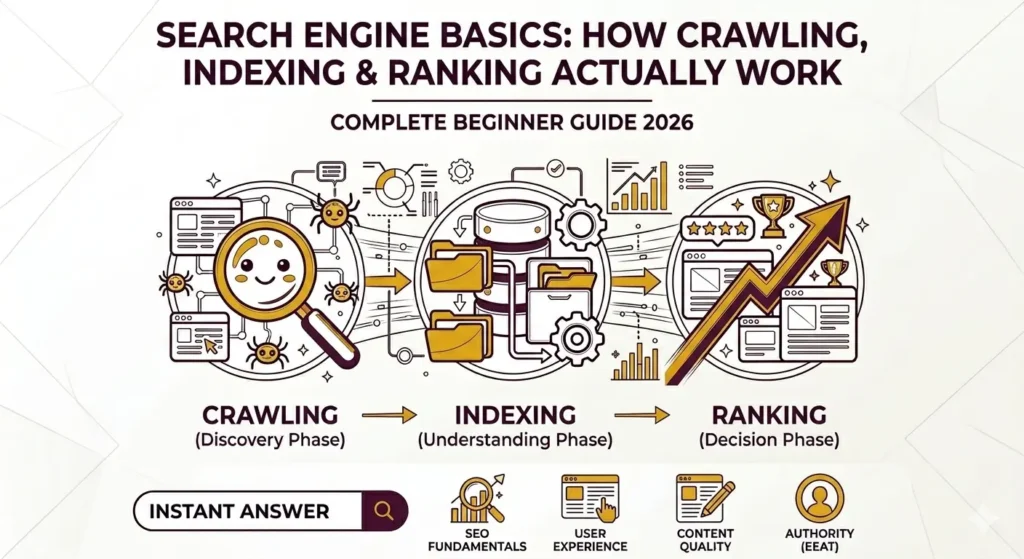
Search engine basics refer to the core processes that search engines use to discover, understand, and rank web pages.
These processes include:
- Crawling (finding pages)
- Indexing (storing and understanding them)
- Ranking (deciding which pages appear first)
If your page fails at any one of these steps, it will not rank — no matter how good your content is.
How Search Engines Work (Simple Explanation)
Search engines don’t search the internet in real-time.
Instead, they:
- Continuously scan the web
- Store data in massive databases
- Instantly retrieve and rank results when a user searches
Think of it like a library:
- Crawling = finding books
- Indexing = organizing books
- Ranking = choosing the best book for a question
The Three Core Processes
1. Crawling (Discovery Phase)
Crawling is how search engines find your website.
Bots (also called spiders) follow links from one page to another and discover new content.
What affects crawling:
- Internal linking
- Backlinks
- Site structure
- Crawl budget
Important concept: Crawl Budget
Every website gets a limited number of pages crawled.
If your site has:
- Too many low-quality pages
- Broken links
- Duplicate URLs
Then important pages may be ignored.
How to improve crawling:
- Submit XML sitemap
- Use clean URLs
- Fix broken links
- Keep important pages close to homepage
- Avoid blocking pages in robots.txt
2. Indexing (Understanding Phase)
Once a page is crawled, search engines analyze and store it.
This is called indexing.
Only indexed pages can appear in search results.
Why pages don’t get indexed:
- Thin or low-quality content
- Duplicate content
- Noindex tags
- Poor structure
Important concept: Semantic understanding
Search engines don’t just read words — they understand meaning.
Example:
A page about “SEO basics” may also rank for:
- how search engines work
- crawling and indexing
- ranking factors
How to improve indexing:
- Write high-quality content
- Avoid duplication
- Use proper headings (H1, H2, H3)
- Add internal links
- Use canonical tags
3. Ranking (Decision Phase)
Ranking is where competition happens.
Search engines evaluate hundreds of signals to decide:
Which page deserves to be #1
Key ranking factors:
1. Content relevance
Does your page match search intent?
2. Backlinks
Do other trusted sites link to you?
3. User experience
- Page speed
- Mobile usability
- Layout stability
4. Search intent match
Are you solving the exact problem?
5. Authority (EEAT)
- Experience
- Expertise
- Trust
What Affects Search Engine Rankings?
Here are the most important SEO factors simplified:
High Impact
- Content quality
- Search intent match
- Backlink quality
Medium Impact
- Internal linking
- Site structure
- Mobile optimization
Technical Factors
- Core Web Vitals
- HTTPS
- Page speed
What Is SEO (And Why It Matters)?
SEO (Search Engine Optimization) is the process of improving your website so it can:
- Be found easily
- Be understood clearly
- Rank higher consistently
SEO has 3 main parts:
1. On-page SEO
- Content
- Headings
- Keywords
- Meta tags
2. Technical SEO
- Speed
- Mobile-friendliness
- Crawlability
3. Off-page SEO
- Backlinks
- Authority
- Brand signals
Keyword Research & Search Intent
Keywords connect users with your content.
But modern SEO is not just about keywords — it’s about intent.
Types of search intent:
1. Informational
“how search engines work”
2. Navigational
“search console login”
3. Commercial
“best SEO tools”
4. Transactional
“buy SEO course”
Pro Tip:
Long-tail keywords are easier to rank.
Example:
- SEO basics
- search engine basics for beginners 2026
Technical SEO Fundamentals
Even great content won’t rank if your site is broken.
Key technical factors:
Page Speed
- Slow sites = lower rankings
Mobile-First Indexing
- Google ranks your mobile version first
HTTPS
- Security is a ranking factor
Site Structure
- Flat structure = better crawling
Core Web Vitals Explained
These measure user experience:
- LCP (loading speed)
- INP (interaction speed)
- CLS (visual stability)
Poor scores = ranking drop
Content Quality & EEAT
Modern SEO is based on trust.
EEAT stands for:
- Experience
- Expertise
- Authority
- Trust
What high-quality content looks like:
- Helpful
- Accurate
- In-depth
- Easy to understand
Avoid:
- Keyword stuffing
- AI spam content
- Thin articles
Internal Linking & Topical Authority
- Single article ≠ strong SEO
- Cluster strategy wins
Example:
- Main page: search engine basics
- Supporting pages:
- keyword research guide
- technical SEO
- backlinks guide
This builds topical authority
SERP Features & Search Evolution
Search results are no longer just links.
Now include:
- Featured snippets
- People Also Ask
- Videos
- Images
- AI answers
To rank higher:
- Answer questions clearly
- Use structured headings
- Add concise definitions
AI Search & Future of SEO (2026)
Search is evolving fast.
Key trends:
- AI-generated answers
- Intent-based ranking
- Voice search
Meaning:
Content must be:
- Clear
- Helpful
- Human-focused
Common SEO Mistakes That Kill Rankings
Avoid these:
1. Thin content
Low-value pages hurt entire site
2. Ignoring search intent
Wrong content type = no ranking
3. Slow website
Users leave → rankings drop
4. Low-quality backlinks
Can lead to penalties
5. No strategy
Random content = no traffic
Search Engine Algorithms & Google Updates
Search engines do not stay the same. Google updates its algorithm regularly to improve the quality of search results.
An algorithm is a system of rules that decides how pages are ranked. These rules are constantly refined based on user behavior, content quality, and new technologies.
There are different types of updates:
- Core Updates: Broad changes that impact rankings across many industries
- Helpful Content Updates: Focus on rewarding content written for humans
- Spam Updates: Target manipulative SEO practices
What this means for you is simple:
You cannot rely on shortcuts. Content that is genuinely helpful, accurate, and well-structured tends to survive updates and often improves over time.
Websites that lose rankings after updates usually have:
- Thin or low-value content
- Poor user experience
- Weak authority signals
To stay safe, focus on long-term quality instead of short-term tricks.
SEO Audit: How to Evaluate Your Website Properly
An SEO audit is the process of analyzing your website to identify issues that may be affecting rankings.
It helps you understand what is working and what needs improvement.
A proper audit includes:
Technical checks:
- Page speed and Core Web Vitals
- Mobile usability
- Crawl errors and indexing issues
Content checks:
- Keyword targeting
- Content depth and quality
- Duplicate or thin content
Authority checks:
- Backlink quality
- Domain trust signals
Doing regular audits ensures your site stays optimized as search engines evolve.
Instead of guessing what is wrong, an audit gives you clear direction.
Internal Linking Strategy (Advanced Level)
Internal linking is more powerful than most beginners realize.
It is not just about navigation — it directly affects how search engines understand your site.
A strong internal linking strategy helps:
- Distribute authority across pages
- Highlight your most important content
- Improve crawl efficiency
One advanced approach is the “silo structure.”
In this model:
- A main pillar page targets a broad topic
- Supporting pages cover subtopics
- All pages link to each other in a logical way
This creates a clear topical relationship and signals expertise to search engines.
- Also pay attention to anchor text.
- Use descriptive, natural phrases instead of generic words like “click here.”
Content Optimization with Semantic SEO
- Modern SEO is no longer about repeating the same keyword multiple times.
- Search engines now understand context, meaning, and relationships between topics.
- This is where semantic SEO comes in.
Instead of focusing on one keyword, you cover:
- Related terms
- Synonyms
- Subtopics
- User questions
For example, a page about search engines should naturally include concepts like:
- Crawling
- Indexing
- Ranking
- Algorithms
- Search intent
- This approach helps search engines fully understand your content.
- It also improves your chances of ranking for multiple related queries instead of just one keyword.
Topical Authority: The Key to Long-Term Rankings
- Topical authority means becoming a trusted source in a specific subject area.
- Instead of publishing random articles, you focus deeply on one niche and cover it completely.
This is done through a content cluster strategy:
- One pillar page (broad topic)
- Multiple supporting articles (detailed subtopics)
- Strong internal linking between them
For example:
A pillar page on “SEO basics” can be supported by articles on:
- Keyword research
- Technical SEO
- Link building
- Content optimization
Over time, this structure tells search engines:
“This website is not just relevant — it is an authority.”
Topical authority is one of the biggest differences between sites that rank temporarily and sites that dominate search results consistently.
Frequently Asked Questions
Final Takeaway
Search engines are not random.
They follow a system:
Discover → Understand → Rank
If your content:
- Solves real problems
- Matches user intent
- Is technically optimized
Then rankings become predictable — not luck.